
Buyer's guide
Buying a service robot: what you need to decide beforehand
Choosing the right model is the last step, not the first. Those who start with the question "which robot?" end up comparing data sheets and buying the wrong product for their needs.
This page goes through the decisions in the order they need to be made. It then explains what's included in an offer, why there are no prices listed here, and how we handle rent and the term AI. The models are explained further down.
Five decisions, in this order
Each of these questions narrows down the selection. Answering them in this order will result in two or three models instead of thirty.
Decision 1
Which task should be eliminated?
It's not "we want a robot," but "this route, this area, this handle." The more narrowly defined the task, the clearer the choice. Anyone who wants to solve three tasks simultaneously will get a compromise solution for each one.
Result: a named task with frequency and time required per day.
Decision 2
In what environment
Restaurant, nursing home, clinic, hotel, office building, hall. The environment determines the building design, noise levels, hygiene requirements, and whether the device operates among people or in an open area.
Result: Environment type plus special features, such as night operation or public traffic.
Decision 3
What load, what area
For transport: the heaviest load on the route, not the average. For cleaning: the area in square meters and the type of flooring. This figure excludes most models, and that's its purpose.
Result: Load capacity in kilograms or area in square meters.
Decision 4
Trial period or direct purchase
This is the decision that involves the most money, and most people make it too late. The next section will discuss this further.
Result: one of the two types of offer.
Decision 5
Who is responsible for the device during operation?
A designated person is needed to start the robot, respond to messages, and report malfunctions. Without this person, any device will stop working after a few weeks. This is the most common reason for failed projects, not the technology itself.
Result: one name, no department.
Trial period or buy directly
We work with exactly two types of offers. This is a conscious decision because any additional variation would destroy comparability.
With test phase
The device will run for an agreed period of time in real-world operation, after which a decision will be made.
- If the route contains unknowns, such as an elevator without a clearly defined interface
- If no one in the house has ever worked with a robot before
- If acceptance within the team is unclear
- When multiple departments need to approve and require supporting documents
Purchase without trial period
Direct purchase, setup and handover in one step.
- If a comparable device is already running in the house
- If the environment is simple, one floor, clear paths
- When the need is clear and time pressure is high
- If the task is narrowly defined and measured
A trial period is not a free demonstration. It is a paid period with a clear end and clear acceptance criteria. Without these criteria, it becomes a long-term loan where no one makes a decision.
What's in an offer
A quote for a service robot isn't just a single line item. These items appear, and only those who understand them can actually compare quotes.
| Post | What's behind it | Always needed |
|---|---|---|
| Gerät | The robot itself, in the selected version | ja |
| Charging or docking station | Location, power connection, space requirements | ja |
| Establishment and mapping | Create a map of the building, define routes and parking spaces | ja |
| Training | Training for the people who use the device in everyday life | ja |
| Elevator integration | Preliminary project and main project, only when changing floors | only if there are multiple floors |
| Accessories | Trays, container assembly, lifting plate, brushes and pads | depending on the task |
| Service and Support | Response times, spare parts, remote access | recommended |
| Transport and delivery | Delivery and commissioning on site | ja |
If an offer only lists the device, other items are missing. This doesn't make it cheaper, just more incomplete.
Why there are no prices here
Because quoting a price without specifying the function would be misleading. The same model costs different amounts in two stores, and the difference is not in the device itself.
What influences the price: the number of devices, which depends on the frequency of use; the number of floors and therefore the elevator integration; the number of charging points and whether additional construction is required; the accessories, which are specific to the project; and whether or not the project will start with a test phase.
Therefore, we only provide a price quote in the offer, and then in full. The service robot configurator gives an initial estimate , while the cleaning robot calculator provides a rough estimate for cleaning areas.
Rental, leasing and RaaS
In short: we do not rent out service robots for continuous operation . We offer two types of services: a trial period and a purchase. Rental, leasing, and Robot-as-a-Service are not included.
The reason isn't a rigid adherence to principles. A service robot in continuous operation needs a configured map, defined routes, trained operators, and designated responsibilities. A rented device that's decommissioned after eight weeks doesn't receive this integration, and therefore performs worse than it could.
There is one exception: events . For trade fairs, events, and individual occasions, short-term use is exactly the right approach. This is handled through event rental.
If you want to test the robot without buying it, the trial period is the right way to go, not renting.
AI in service robots: what's real?
Those looking to buy an AI robot are usually asking exactly this question. The term AI appears in almost every brochure. Some of it is real, some is just a marketing gimmick. When buying, the difference is important because it determines what the device does in case of a malfunction.
Authentic and relevant
- Navigation and mapping: the device creates a map and locates itself within it.
- Obstacle detection: People, vehicles, and objects are distinguished.
- Route planning: a new route is calculated if the old one is blocked.
- Speech recognition on devices with addressable input in the guest room
Label, not function
- A device doesn't get smarter just because it runs longer. Cards remain cards.
- It does not decide for itself which task is meaningful.
- It does not detect any process errors in your operation
- It does not replace a judgment that a person would have to examine.
Practical advice for buyers: Don't ask if the device has AI. Ask what it does when the gear is blocked, when the map no longer fits, and when the connection drops. The answers to these three questions say more than any data sheet.
Manufacturer or integrator
We don't build robots. SEBOTICS is an integrator, which means: we select from the market, set up the devices for a specific environment, train the operators and support them during operation.
The difference is important when making a purchase. A manufacturer sells their own device, even if another one would be a better fit. An integrator can say no, and if they take their work seriously, they will. The trade-off is that we are dependent on the manufacturer for significant firmware modifications.
What we provide: selection, setup, mapping, training, support, spare parts, and communication between your operation and the manufacturer. What the manufacturer provides: the device, the firmware, and the warranty.
The models at a glance
Below are the devices we use for service and transport, each with a picture and brief description. The order does not indicate suitability. Which model is right for you depends on the five decisions made above.
Here's a video to give you an idea of the scale:
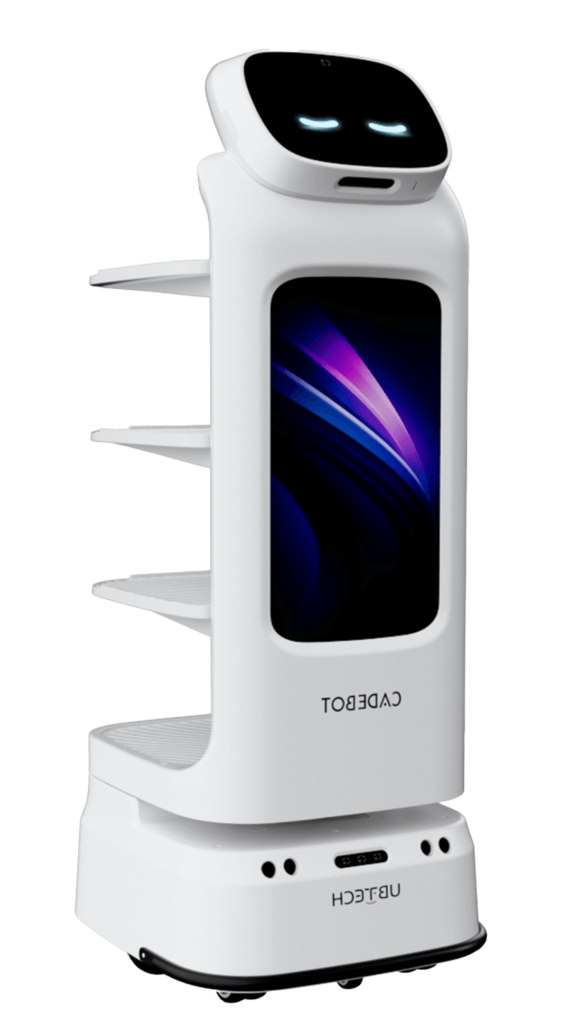
Cadebot L100
Serving, delivery and promotion robots
mass of the machine
Shelf size
Battery life
charging
weight of the robot
passage width
volume
Speed
Tilt
551 * 484 * 1265 mm
426 x 398 mm
8 – 12 hours depending on the setting
4,5h
55 kg
65 cm
0,5 -0,8 m/s, individually adjustable
max. 5 °
Battery life
8 – 12 hours depending on the setting
charging
4,5h
weight of the robot
55 kg
mass of the machine
551 * 484 * 1265 mm
Dimensions of shelves
426 x 398 mm
volume
Speed
0,5 -0,8 m/s, individually adjustable
passage width
65 cm
Tilt
max. 5 °
Cadebot L100 is more than just a delivery robot. Its large, high-resolution screen also makes it perfect for use in the promotional sector.
Its features include dynamic orientation, open shelves, and an improved chassis for convenient servicing. Cadebot The L100 is brilliant through and through.
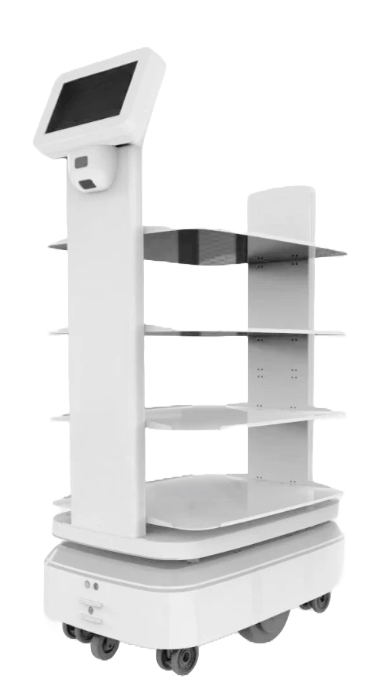
AutoXing D-150
delivery robot
mass of the machine
Shelf size
Battery life
charging
passage width
volume
Speed
Tilt
Loading capacity
lifting function
Lift connection
50 cm wide, 74 cm long 124 cm high
60 42,4 cm x cm
>10 h depending on the setting
4 h
70 cm
1 m/s, individually adjustable
max. 5 °
Up to 150 kg
No
Yes, possible
mass of the machine
50 cm wide, 74 cm long 124 cm high
Dimensions of the shelves
60 42,4 cm x cm
Battery life
>10 h depending on the setting
charging
4 h
passage width
70 cm
volume
Speed
1 m/s, individually adjustable
Tilt
max. 5 °
Loading capacity
max. 150 kg
lifting function
No
Lift connection
Yes, possible
AutoXing D-150 of Sebotics is a versatile delivery robot suitable for a variety of tasks, including restaurant automation, warehouse assistance, and precise deliveries.
It features an impressive load capacity of up to 150 kg and is suitable for both indoor and outdoor use.
Thanks to its special chassis, the robot can move easily in various environments, even in elevators. With advanced navigation algorithms, it maintains its position. AutoXing D-150 always provides orientation.
AutoXing The D-150 offers a battery life of over 10 hours depending on the setting.

AutoXing D-300
Delivery robot carrying platform
mass of the machine
Platform size
Battery life
charging
passage width
volume
Speed
Tilt
Loading capacity
lifting function
Lift connection
60 cm wide, 90 cm long 124 cm high
80cm long x 60cm wide
>10 h depending on the setting
4 h
70 cm
1 m/s, individually adjustable
max. 5 °
Up to 300 kg
No
Yes, possible
mass of the machine
60 cm wide, 90 cm long 124 cm high
Dimensions of the shelves
80cm long x 60cm wide
Battery life
>8 h depending on the setting
charging
4 h
passage width
70 cm
volume
Speed
1 m/s, individually adjustable
Tilt
max. 5 °
Loading capacity
max. 300 kg
lifting function
No
Lift connection
Yes, possible
AutoXing D-300 of Sebotics is a versatile delivery robot with a carrying platform.
It features an impressive load capacity of up to 300 kg and is suitable for both indoor and outdoor use.
Thanks to its special chassis, the robot can move easily in various environments, even in elevators. With advanced navigation algorithms, it maintains its position. AutoXing D-300 always provides orientation.
AutoXing The D-300 offers a battery life of over 8 hours depending on the setting.

AutoXing L-600
Delivery robot carrying platform
mass of the machine
Platform size
Battery life
charging
passage width
volume
Speed
Tilt
Loading capacity
lifting function
Lift connection
60 cm wide, 95 cm long 124 cm high
80cm long x 66cm wide
>8 h depending on the setting
4 h
80 cm
1 m/s, individually adjustable
max. 5 °
Up to 600 kg
No
Yes, possible
mass of the machine
60 cm wide, 90 cm long 124 cm high
Dimensions of the shelves
80cm long x 60cm wide
Battery life
>8 h depending on the setting
charging
4 h
passage width
80 cm
volume
Speed
1 m/s, individually adjustable
Tilt
max. 5 °
Loading capacity
max. 600 kg
lifting function
No
Lift connection
Yes, possible
AutoXing L-600 of Sebotics, a high-performance service robot, designed for optimal efficiency and flexibility in your work environment. Perfectly suited to safely transporting materials to their destination, it provides AutoXing The L-600 is the ideal choice for applications ranging from warehouses to hotels.
It enriches your everyday work with its state-of-the-art technology. It can carry an impressive load of up to 600 kg.

AutoXing L-300
lifting robot
mass of the machine
Platform size
Battery life
charging
passage width
volume
Speed
Tilt
Loading capacity
lifting function
Lift connection
71 cm long, 50 cm wide, 124 cm high
65cm x 50cm wide
>10 h depending on the setting
4 h
70 cm
1 m/s, individually adjustable
max. 5 °
Up to 300 kg
Ja
Yes, possible
mass of the machine
71 cm long, 50 cm wide, 124 cm high
Dimensions of the shelves
65cm x 50cm wide
Battery life
>8 h depending on the setting
charging
4 h
passage width
70 cm
volume
Speed
1 m/s, individually adjustable
Tilt
max. 5 °
Loading capacity
max. 300 kg
lifting function
Ja
Lift connection
Yes, possible
The AutoXing L-300 is an innovative solution for a wide range of requirements – from restaurant automation, warehouse support, industry to precise delivery.
It can lift and put down goods independently. We are talking about a load capacity of up to 300 kg.

BellaBot
serving robot
mass of the machine
weight of the robot
Materials
charging
Battery life
driving speed
load
565 * 537 * 1290 (mm)
57 kg
ABS/aluminum alloy
4,5 h (manual charge)
12-24 h (replaceable battery)
0,5-1,2m/s, adjustable
10 kg/shelf, up to 40 kg
mass of the machine
565 * 537 * 1290 (mm)
weight of the robot
57 kg
Materials of the machine
Aerospace grade ABS/Aluminium alloy
charging
4,5 h (manual charge)
Battery life
12-24 h (replaceable battery)
cruise speed
0,5-1,2m/s, adjustable
load
10 kg/shelf, up to 40 kg
Do you want to create better working conditions for your employees? With the BellaBot achieve it effortlessly.
The robot takes over the long journeys and the heavy lifting, giving employees more time for what they really enjoy – looking after guests.
Thanks to its replaceable battery, it can operate 24 hours a day, 365 days a year, without any loss of power. BellaBot However, it not only serves to promote service quality, but also acts as an excellent magnet to attract new guests to your business.

KettyBot Pro
Serving and reception robot with advertising screen
mass of the machine
weight of the robot
load
charging
Battery life
passage width
ø Speed
screen size
× × 451 436 1103 mm
38 kg
30 kg
4,5 h (automatic charging)
10-24 h
≥55cm
Up to 1,2 m/s
18,5 inch
mass of the machine
× × 451 436 1103 mm
weight of the machine
38 kg
load
30 kg
charging
4,5 h (automatic charging)
Battery life
10-24 h
passage width
≥55cm
cruise speed
Up to 1,2 m/s
mass d. advertising screen
18,5 inch
Guaranteed eye-catching advertising! Inspire your customers and guests before you even enter your business with offers, new products and recommendations without any effort. KettyBot Pro recognizes people, approaches them and invites them to interact.
Thanks to the touchscreen and companion function of the KettyBotThis relieves the burden on employees while still allowing customers and guests to be guided effortlessly and quickly to their desired location, be it a table in a restaurant, the lockers in a shopping center, or a booth at a trade fair.

HolaBot
collecting robot
mass of the machine
weight of the robot
Materials
charging
Battery life
driving speed
load
541 × 531 × 1226 (mm)
60 kg
ABS/aluminum alloy
4,5 h (manual charge)
12-24 h (replaceable battery)
0,5-1,2m/s, adjustable
15 kg/shelf, (4 shelves)
mass of the machine
541 × 531 × 1226 (mm)
weight of the robot
60 kg
Materials of the machine
Aerospace grade ABS/Aluminium alloy
charging
4,5 h (manual charge)
Battery life
10-24 h (replaceable battery)
cruise speed
0,5-1,2m/s, adjustable
load
15 kg/shelf (4 shelves)
Ensure cleanliness and quality in your business effortlessly. With the HolaBot Tables can be cleared efficiently and quickly. Dirty dishes are transported to the washing up out of sight, which further promotes hygiene indoors.
Thanks to the call function, employees can HolaBot Call them to the table. This way, clearing the table is done quickly and saves staff from having to make multiple trips between the washing-up area and the table. This leads to more relaxed work and less heavy lifting.

FlashBot Max
delivery robot
mass of the machine
weight of the robot
Materials
charging
Battery life
driving speed
load
565 * 537 * 1290 (mm)
57 kg
ABS/aluminum alloy
4,5 h (manual charge)
12-24 h (replaceable battery)
0,5-1,2m/s, adjustable
10 kg/shelf, up to 40 kg
mass of the machine
539 * 515 * 1050 (mm)
weight of the machine
50kg
Materials of the machine
Aerospace grade ABS/Aluminium alloy
charging
4,5 h (automatic charging)
Battery life
10 h
cruise speed
0,5-1,5m/s, adjustable
Hold
2-4 compartments (adjustable)
219*410*286mm (single)
438*410*286mm (double)
load
13 kg/shelf, up to 30 kg
By the FlashBot Max Employees in a wide range of industries will have more time for their core tasks: service staff will be relieved of room service, nursing staff will have more time for patients, and in logistics companies and large offices, correspondence can be handled autonomously.
Furthermore, food or medicines remain fresh thanks to the sterile interior areas of the FlashBots always meet the highest hygienic standards.
This is only possible thanks to the unique technology of the FlashBots: He operates lifts independently and sends a message to the recipient upon arrival at the destination.

AutoXing Hotel Bot
delivery robot
mass of the machine
weight of the robot
path release
charging
Battery life
driving speed
Hold
load
488 * 593 * 1281 mm
59 kg
80 cm
4,5 h (automatic charging)
12-24 h
0,5-1,2m/s, adjustable
3 to max. 5 shelves
433 * 502 mm
35 kg
mass of the machine
488*593*1281 mmWeight of the machine59kgPath clearance80cmCharging time4,5 h (automatic charging)Battery life10-24 hRound speed 0,5-1,2 m/s, adjustableCargo space3 to max. 5 shelves433*502 mmLoad capacity35 kg
The AutoXing Hotel Bot is an intelligent delivery robot that improves service in the catering, hotel and other industries. With a load capacity of up to 35 kg and up to 5 trays, it transports food, drinks or goods safely and reliably.
Thanks to its advanced navigation technology, the AutoXing Hotel Bot detects obstacles in real time and automatically adjusts its route. With a minimum passage width of 80 cm, it navigates effortlessly through narrow spaces, ensuring efficient operation.
With its modern design, high load-bearing capacity and automatic door for hygienic and safe deliveries, the AutoXing Hotel Bot sets new standards in service automation, for efficient, intelligent and reliable delivery solutions!
Which category best suits your task?
Service robot is a collective term. These pages will guide you through the specific selection process, each with its own relevant criteria.
| Task | What is being checked there | Page |
|---|---|---|
| Moving loads within the building | Door widths, thresholds, elevator, load capacity | Transport robots |
| Intralogistics in the hall and warehouse | Trips per day, lap time, handover, forklift traffic | Robots in logistics |
| Clean surfaces | Square meters, floor covering, obstacle density | Buy a cleaning robot |
| Commercial cleaning services at a glance | Selection based on object and area | cleaning robots for commercial use |
| Service in the dining area | Aisle width, trays, addressing guests | BellaBot |
| Single event or trade fair | Timeframe, transport, on-site support | event rental |
| care facility | Which tasks can be delegated and which cannot | robots in care |
| Hospital | Airlocks, hygiene zones, bed lift, night operation | Robots in the hospital |
What happens after signing
Five steps, in that order. The longest one is not the delivery.
Step 1:
Appointment and preparation
Select a charging point, check the power outlet, obtain approvals. Anything left undone here will delay the start later.
Step 2:
Delivery and assembly
Delivery, setup, and commissioning of the charging station. Half a day, if the preparation is adequate.
Step 3:
Mapping and routes
The device surveys the surroundings and creates a map. Then routes, parking spaces, and time windows are defined. This is where the smooth operation of the system is determined.
Step 4:
Training
Training for those who will use the device on a daily basis. Starting, acknowledging, reporting malfunctions, cleaning the device.
Step 5:
Accompanied start
The first few days of live operation with fine-tuning. Routes are being adjusted, time windows moved, and special cases clarified.
Frequently asked questions
How much does a service robot cost?
The price is determined more by the number of devices, floors, charging points and accessories than by the model.
Therefore, we list prices in the offer, and they are complete there. The configurator provides a first indication of the price range.
Can I rent a service robot?
Not for continuous operation. Yes, for events, via event rental.
For continuous operation, a device needs maps, routes, training, and responsibility. Rental agreements don't provide this integration. A trial period is available for testing.
How long will it take until deployment?
After delivery, mapping, routing and training are the time-consuming parts, not the setup.
For a floor without an elevator, the timeframe is short. As soon as an elevator interface is involved, the appointment depends on the elevator manufacturer.
Baut SEBOTICS The robots themselves?
No. We are an integrator: selection, setup, training and support.
The device and firmware come from the manufacturer. The advantage for you is that we can also advise against a particular model.
What about AI in these devices?
Navigation, obstacle detection, and route planning are real. Independent decision-making about tasks is not.
Three questions are more meaningful than the word AI: what does the device do when the path is blocked, when the environment changes, and when the connection is lost?
Do I need a trial period?
Useful if the environment contains unknowns or if a robot has never been in the house before.
If a comparable device is already in use and the task is narrowly defined, a direct purchase is faster and cheaper.
Who uses the device on a daily basis?
A designated person, not a department.
This is the most common reason for failed projects. Without accountability, no one responds to reports and the device is shut down.
Request purchasing advice
Describe the task, the environment, and how often it occurs. We will suggest two or three models, explain what a quote would include, and be honest if we advise against a purchase.